What Can You Customize When Ordering Kids Accessories for Your Retail Brand?
October 31, 2026
When global retail brands, toy distributors, and wholesale chains look to expand their product lines, sourcing generic items off the shelf rarely drives long-term customer loyalty. Buyers often ask: What can you customize when ordering kids accessories to secure a distinct market advantage? You can fully tailor material compositions, safety certifications, IP character styling, structural design, and eco-friendly packaging to match your exact brand guidelines. Customization transforms standard commodities into proprietary retail collections that stand out on competitive shelves. This comprehensive guide outlines every customizable aspect of kids accessories manufacturing, detailing how OEMs and ODMs turn raw design concepts into market-ready products.
1. Material Selection and Safety Compliance Standards
Choosing the right raw materials forms the foundation of any successful children’s accessory line. Young consumers require materials that withstand daily wear while meeting strict international safety mandates. Manufacturers utilize hypoallergenic metals, food-grade silicone, non-toxic plastics, and organic or recycled textiles.
When you specify materials, you control the tactile experience and the durability of the final product. For instance, children’s jewelry must avoid lead, cadmium, and nickel to protect sensitive skin. Hair accessories require reinforced elastic cores that retain tension without snapping or pulling hair.
Safety compliance dictates whether your products can legally enter key international markets. Production partners must align with rigorous frameworks such as CPSIA in the United States, EN71 in Europe, and ASTM standards globally.
During the development phase, you select specific testing protocols for heavy metal content, phthalates, and choking hazards. Sourcing from certified factories ensures your supply chain remains transparent and fully accountable from the initial prototype run to bulk delivery.
2. Intellectual Property (IP) Licensing and Character Integration
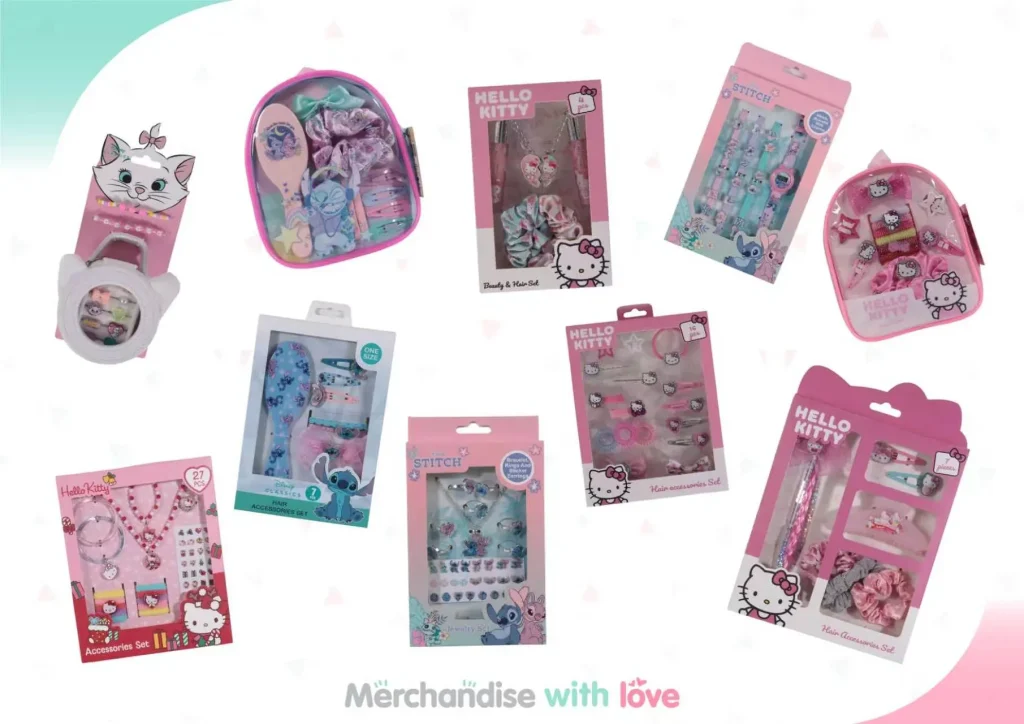
Integrating recognizable intellectual property into children’s collections drives immediate consumer engagement and retail sell-through. Working with licensed characters requires strict adherence to brand style guides, color matching, and approval workflows. Manufacturers bridge the gap between creative IP owners and mass production facilities.
You can customize various categories with licensed designs, ranging from classic animated figures to trending gaming characters. For example, adding official characters to hair items and daily utility goods elevates perceived retail value. You can explore specialized options like wholesale kids jewelry and accessories with IP licensing to see how licensed motifs integrate into wearable items.
Translating 2D artwork into 3D molded charms, embossed bag panels, or printed textile patterns requires precise tooling. Factories create custom molds for keychains, zipper pulls, and hair clips that capture exact character proportions.
Rigorous approval milestones ensure that every piece meets the licensor’s quality standards before mass production begins. This meticulous approach protects brand integrity while delivering items that children instantly recognize and love.
3. Structural Design and Functional Customization
Beyond aesthetics, functional design determines how well a product performs for its intended age demographic. Children’s bags, travel gear, and utility items require ergonomic adjustments, secure closures, and appropriate sizing. You can modify strap lengths, add reinforced base panels, or incorporate specialized interior compartments.
Functional customization extends across diverse product lines, from school gear to wearable novelties. Retailers often request multi-functional items, such as convertible bags or modular accessory sets. You can examine practical layout options via wholesale kids backpacks and school bags to understand standard sizing and structural capabilities.
| Customization Area | Standard Options | Tailored Retail Options | Key Benefit |
| Bags & Backpacks | Standard polyester, basic zippers | Ergonomic padding, waterproof coatings, custom pullers | Enhanced comfort and longevity |
| Hair Accessories | Standard elastics, metal clips | Reinforced bands, soft-touch coatings, custom shapes | Prevents hair snagging and breakage |
| Jewelry & Charms | Zinc alloy, standard plating | Lead-free stainless steel, enamel infills, custom molds | Ensures skin safety and unique branding |
Ready to Elevate Your Children’s Accessory Line?
Contact our team today to discuss your custom manufacturing requirements, request material samples, or review factory audit documentation.
4. Packaging, Branding, and Retail-Ready Presentation
Packaging serves as the final touchpoint that converts browsers into buyers in a crowded retail environment. Custom packaging options range from eco-friendly paper backing cards and biodegradable polybags to branded gift boxes and display counter units. You dictate the exact visual hierarchy to match your corporate identity.
Retail chains often require specific barcode integration, hangtags with multi-language warnings, and shelf-ready packaging (SRP) configurations. These specifications streamline logistics and reduce in-store preparation time for retail staff.
Custom inserts secure delicate items like hair bows or cosmetic sets during transit, ensuring they arrive on shelves in pristine condition.
Brand differentiation often happens at the packaging level. Embossed logos, custom color palettes, and windowed boxes allow consumers to view product textures prior to purchase.
Collaborating with an experienced manufacturer allows you to test different packaging formats for shipping efficiency. Optimizing carton dimensions reduces freight costs while protecting fragile components like sunglasses or delicate enamel charms.
Frequently Asked Questions
What is the typical Minimum Order Quantity (MOQ) for custom kids accessories?
Minimum order quantities vary based on material complexity and mold requirements. Standard items typically start around 1,000 to 3,000 units per design, while custom-molded items may require higher volumes to offset initial tooling costs.
How long does the product development and sampling process take?
Initial prototyping generally takes between 7 to 15 days, depending on design intricacy. Once you approve physical samples and sign off on technical specifications, mass production typically requires 30 to 45 days.
Can manufacturers assist with compliance testing for our target market?
Yes. Professional manufacturers coordinate third-party laboratory testing through accredited agencies like SGS or Intertek. They ensure that production batches comply with regional regulations such as CPSIA, EN71, and REACH.
What file formats are required for custom product design?
Factories typically require vector files in AI, EPS, or PDF format for graphics and Pantone (PMS) color codes for precise color matching. 3D technical drawings (STEP or IGHS files) are necessary for custom molded items.
About COOLS Accessories
Headquartered in Yiwu, China’s premier global commodity hub, COOLS Accessories operates as a dedicated product development partner and end-to-end manufacturer for children’s goods. By integrating specialized OEM and manufacturing capabilities, strict quality control protocols, and seamless export coordination, the company helps global brands, wholesalers, and retail chains scale efficiently. The experienced team collaborates directly with international buyers to design, prototype, and mass-produce market-ready collections across hair accessories, jewelry, custom bags, keychains, sunglasses, beauty sets, and seasonal novelties.
References
- United States Consumer Product Safety Commission (CPSC) – Kids Products Safety Guidelines: https://www.cpsc.gov/
- European Commission – Toy Safety Directive and Standards: https://single-market-economy.ec.europa.eu/
- ASTM International – Standard Consumer Safety Specifications for Toy Safety: https://www.astm.org/