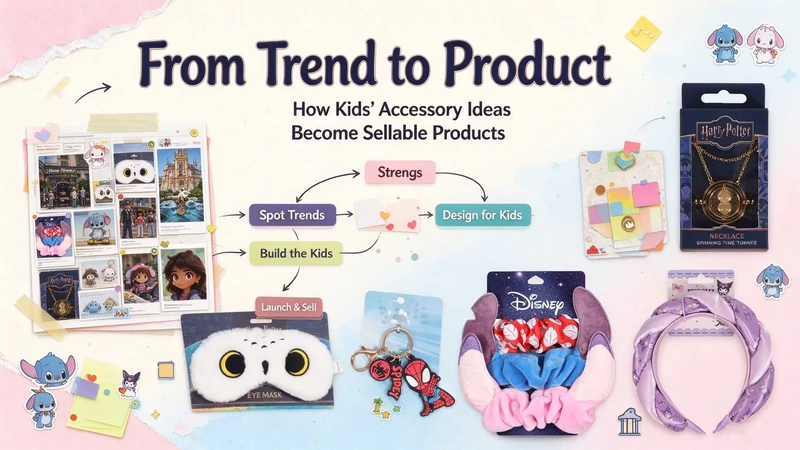
From Trend to Product: How Kids Accessory Ideas Become Sellable Products
October 8, 2026
A successful kids accessory rarely starts with a finished product. It often begins with a trend, a color, a character, a visual detail, or a simple idea spotted in the market.
But turning that idea into a product that buyers actually want to order requires much more than creativity. The idea needs to be evaluated, developed, sampled, refined, manufactured, packaged, and prepared for the retail market.
For brands, wholesalers, retailers, and private-label buyers, understanding this process can make product development more efficient and reduce unnecessary costs.
Here is how a kids accessory idea can move from a market trend to a sellable product.
1. Start With a Market Trend
The first step is identifying an idea that has commercial potential.
Trends in kids accessories can come from many different sources, including:
- Popular colors and seasonal palettes
- Character and entertainment trends
- Fashion details such as bows, flowers, fruits, or animal motifs
- Social media aesthetics
- Seasonal events and holidays
- Back-to-school shopping
- Gift-giving occasions
- Emerging retail trends
However, a trend alone does not guarantee a successful product.
The key question is:
Can this trend be translated into an accessory that children want and buyers can actually sell?
A good product idea should combine visual appeal with a clear commercial purpose.
2. Turn the Trend Into a Product Concept
Once a trend has been identified, the next step is to turn it into a specific product concept.
For example, a popular visual theme might be developed into:
- Hair clips
- Claw clips
- Headbands
- Scrunchies
- Keychains
- Bag charms
- Mini bags
- Cosmetic pouches
- Children’s sunglasses
- Beauty accessories
Instead of developing one isolated item, buyers can also consider whether the same theme can be extended across several categories.
This creates a more cohesive product range and gives retailers more opportunities to build attractive displays.
3. Define the Target Customer
A product concept should also be developed around a specific target customer.
Age can make a significant difference in kids accessory design.
Younger children may respond better to:
- Bright colors
- Simple shapes
- Soft textures
- Cute characters
- Easy-to-use accessories
Older children may prefer:
- Fashion-inspired designs
- More sophisticated color combinations
- Trend-based details
- Decorative accessories
- Products that reflect current youth culture
Understanding the target age group helps determine the product’s size, materials, colors, decoration, packaging, and overall style.
4. Choose the Right Materials and Decoration
The same design concept can look completely different depending on how it is manufactured.
Materials and decoration techniques can include:
- Fabric
- Plush
- PU
- Polyester
- PP
- Acrylic
- Resin
- Embroidery
- Printing
- Appliqué
- Metal details
- Heat-transfer decoration
For example, embroidery can create a soft and premium appearance, while resin decorations can add a more dimensional effect.
The right combination depends on the product category, target price, design requirements, and expected retail positioning.
This is where product development experience becomes especially important.
5. Create the First Sample
A concept becomes much easier to evaluate once it is turned into a physical sample.
During the sampling stage, buyers can check:
- Overall appearance
- Size and proportions
- Color accuracy
- Material selection
- Decoration details
- Functionality
- Packaging requirements
- Production feasibility
The first sample is not always the final product.
Adjustments may be needed to improve the shape, color, decoration, materials, or construction before the product is ready for production.
An efficient sampling process helps buyers make these decisions before committing to a larger order.
6. Refine the Product for Mass Production
A design may look excellent on paper but still need adjustments before mass production.
For example, a decoration may need to be simplified, a material may need to be changed, or a construction method may need to be optimized.
The goal is to find the right balance between:
Design + Quality + Function + Cost + Production Efficiency
This is one of the most important stages in turning a creative concept into a commercially viable product.
A product needs to look attractive while also being practical to manufacture consistently at larger quantities.
7. Develop Packaging That Supports the Product
Packaging is part of the product experience.
For retail accessories, packaging can help communicate the product’s style and positioning before the customer even picks it up.
Depending on the product, packaging may include:
- Backing cards
- Hanging cards
- Retail boxes
- Clear windows
- Printed sleeves
- Polybags
- Gift packaging
- Customized labels
Good packaging should protect the product while also making it easier to display and understand.
For private-label projects, packaging can also carry the buyer’s own branding and visual identity.
8. Prepare the Product for Retail
Before a product reaches the market, buyers should review the complete retail presentation.
This includes more than the product itself.
Consider:
- Product naming
- SKU information
- Packaging
- Labels
- Barcodes
- Carton packing
- Product photography
- Retail display
- Shipping requirements
A product becomes much easier to launch when these details have been considered from the beginning rather than added at the last minute.
9. Build a Collection Instead of a Single Product
One trend can often generate an entire collection.
For example, a strawberry-inspired concept could be developed into:
Hair Accessories
Claw clips, hair clips, headbands and scrunchies
Bags & Pouches
Mini bags, cosmetic pouches and soft plush bags
Charms & Gifts
Keychains and decorative bag charms
Beauty Accessories
Facial cleaning headbands and wristbands
Packaging
Coordinated retail-ready packaging
Using one visual direction across several categories creates a stronger collection and a more consistent retail presentation.
For buyers, this can also make seasonal displays and themed product programs easier to build.
10. From Product Idea to Commercial Opportunity
The journey from trend to product is not simply about following what is popular.
It is about identifying an opportunity and developing it into something that works commercially.
A successful kids accessory should ideally answer several questions:
- Is the design attractive to the target customer?
- Is the product practical?
- Can it be manufactured consistently?
- Does the cost fit the target price?
- Can the design be extended into other categories?
- Does the packaging work for retail?
- Can the product fit the buyer’s brand identity?
When these elements come together, a simple trend can become a complete product opportunity.
From Trend to Production With the Right Development Partner
For brands and buyers, working with an experienced kids accessories supplier can simplify the journey from an early idea to a finished product.
At COOLS, product development can cover multiple stages of the process, including design development, sampling, OEM/ODM production, customized packaging, quality control, and shipping.
COOLS can also develop private-label products according to a customer’s brand requirements, helping turn an initial concept into a customized product through design, sampling, production, packaging, and delivery.
Whether the project starts with a market trend, a mood board, a product reference, or a completely new concept, the goal is the same:
Turn a promising idea into a product that is ready for the market.
For brands, wholesalers, retailers, and private-label buyers looking to develop new kids accessories, the right process can turn today’s trend into tomorrow’s sellable product.