
How Does the OEM Process Work for Brands Developing Custom Kids Accessories?
September 11, 2026
Original equipment manufacturing follows a structured pathway from initial design concepts to final mass production. Brands partner with an experienced OEM kids accessories supplier to transform technical sketches into market-ready merchandise. The workflow involves technical specification reviews, material sourcing, prototype sampling, laboratory safety testing, and volume manufacturing. Each phase requires clear communication between the brand team and the manufacturing partner to ensure regulatory compliance and product quality. For example, a retail brand wanting to launch a line of silicone hair clips sends vector drawings and Pantone color codes to the factory. The manufacturer evaluates structural feasibility, selects phthalate-free materials, and creates physical samples for client evaluation. Once the brand approves the prototype, the factory initiates mass production runs for global distribution. Understanding this workflow helps procurement managers plan project timelines and budget effectively.
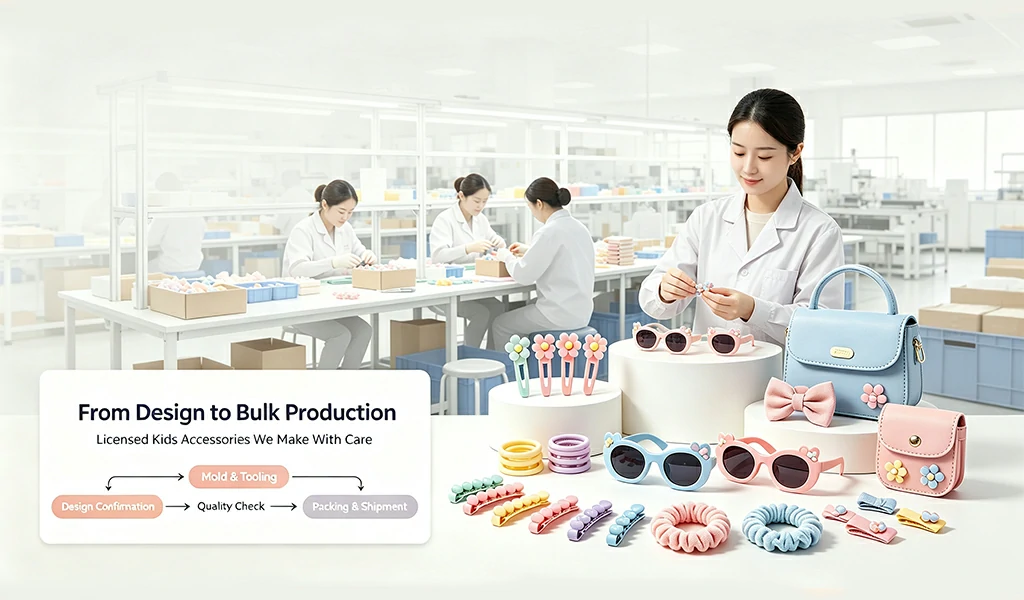
Initial Concept Evaluation and Technical Specification Review
The manufacturing journey begins when a brand submits technical data packages to a custom kids accessories supplier. Product developers review material requirements, dimensional drawings, and target price points during this phase. Safety regulations dictate material selection because items destined for young consumers must meet strict chemical limits. Regulatory bodies enforce limits on lead, cadmium, and phthalates in all items worn or handled by minors. The factory engineering team assesses whether the proposed design meets mechanical safety standards for pull strength and small parts hazards. For instance, tiny decorative buttons on fabric headbands must withstand high tension tests to prevent choking risks. Clear technical documentation prevents costly manufacturing delays and ensures smooth sample development down the line.
- Review vector drawings and 3D renderings for structural feasibility.
- Select compliant, non-toxic materials meeting global safety directives.
- Establish exact Pantone color swatches for dyed fabrics and molded plastics.
- Define precise dimensional tolerances to ensure consistent assembly results.
Material Sourcing and Prototyping Phase
Once engineering teams approve the specifications, sourcing specialists procure compliant raw materials from certified mills. Factories acquire hypoallergenic fabrics, organic cotton yarns, food-grade silicone, and nickel-free metal hardware. Sourcing teams verify material certification documents before cutting or molding begins. The sampling department then builds physical prototypes using the selected materials and specified manufacturing techniques. Brand buyers inspect these samples closely for color accuracy, stitching precision, and overall tactile feel. If adjustments are necessary, the factory modifies the tooling or sewing patterns before scheduling a second sample round. Securing formal approval on final golden samples protects both parties against mass production defects.
- Source hypoallergenic textiles and non-toxic silicone components from verified mills.
- Construct initial physical samples to verify aesthetic and functional appeal.
- Test mechanical closures, elastic stretch rates, and clasp durability thoroughly.
- Adjust sewing patterns and tooling molds based on client feedback before mass production.
Regulatory Compliance and Laboratory Safety Testing
Safety testing represents a non-negotiable step when producing children’s accessories for international retail markets. Independent third-party laboratories test random product samples against regional compliance standards like ASTM F963, EN71, and CPSIA. Technicians subject items to physical torque tests, flammability checks, and chemical extraction analyses. Passing these rigorous evaluations certifies that the merchandise contains no harmful toxins or hazardous sharp edges. Retail buyers require official test reports before accepting shipment into their regional distribution centers. Working with a reliable kids accessories manufacturer that understands global testing protocols minimizes regulatory rejection risks.
- Submit prototype samples to certified third-party laboratories for chemical analysis.
- Conduct physical torque and pull tests to evaluate small parts security.
- Verify compliance with regional safety directives including ASTM F963 and EN71.
- Obtain official test certificates required for international customs clearance.
Mass Production Execution and Quality Control Protocols
Mass production starts only after the client signs off on physical prototypes and laboratory test certificates. The factory schedules raw material cutting, component assembly, stitching, and surface finishing across dedicated production lines. Production supervisors monitor assembly speeds and inspect machine calibrations constantly to maintain strict dimensional tolerances. Quality control inspectors pull random units from the assembly line hourly to verify workmanship and finish consistency. Any defective items trigger immediate line stoppages and root-cause investigations by the factory engineering staff. Implementing strict quality gates ensures that every carton meets the exact standards established during the prototyping phase.
- Schedule dedicated assembly lines for material cutting, stitching, and hardware attachment.
- Monitor machine calibrations and operator output continuously during shifts.
- Execute hourly random inspections to verify workmanship and dimensional consistency.
- Quarantine defective units immediately for root-cause analysis and rework.
Table 1: OEM Production Workflow and Quality Gates
| Workflow Phase | Key Operational Activity | Primary Quality Check |
| Concept Review | Technical drawing and material analysis | Feasibility and safety audit |
| Prototyping | Sample creation and color matching | Dimensional and tensile testing |
| Compliance | Third-party laboratory safety testing | Chemical and physical standard verification |
| Mass Production | High-volume manufacturing and assembly | Hourly random line inspections |
Ready to scale your product line? Contact our team today to discuss your technical specifications and manufacturing requirements.
Packaging, Logistics, and Global Supply Chain Management
Finished merchandise requires protective packaging to withstand long-distance ocean or air transit safely. Packaging engineers design custom polybags, display backing cards, and master cartons optimized for retail shelf presentation. Clear barcode labeling ensures seamless scanning across international distribution hubs and fulfillment centers. Logistics coordinators manage export documentation, customs clearance paperwork, and freight booking to streamline cross-border shipping. B2B buyers sourcing Custom Kids Accessories rely on experienced manufacturing partners to handle export compliance smoothly. Reliable shipping coordination prevents port delays and ensures that seasonal inventory arrives on schedule.
- Design custom retail backing cards and protective polybags for shelf presentation.
- Apply accurate barcode labels to master cartons for efficient warehouse scanning.
- Prepare export documentation and customs clearance paperwork for international transit.
- Coordinate freight booking to ensure timely delivery to global distribution hubs.
Frequently Asked Questions
What files are needed to start the OEM process for accessories?
Brands need detailed tech packs, vector design drawings, Pantone color codes, and target dimensional specifications to initiate manufacturing.
How long does prototype sampling usually take?
Initial prototype sampling generally takes between seven and fifteen days depending on material availability and tooling complexity.
What safety standards apply to retail items for young consumers?
Items must comply with regional standards such as ASTM F963 in the United States and EN71 in the European Union.
Why is third-party laboratory testing necessary before shipping?
Third-party testing verifies that production batches comply fully with chemical and physical safety regulations before entering retail markets.
Cools delivers reliable manufacturing solutions and engineered accessories for global retail brands and wholesalers. Our production facilities specialize in producing durable kids fashion accessories wholesale that meet strict international safety and quality standards. We manage every phase of the manufacturing lifecycle, from initial material sourcing to final export logistics. Our engineering teams help B2B procurement managers secure consistent merchandise for competitive global markets.
References:
- Consumer Product Safety Commission. Toy and Children’s Products Safety Guidelines. https://www.cpsc.gov
- European Committee for Standardization. Safety of Toys Standards. https://www.cen.eu
- ASTM International. Consumer Products Safety Standards. https://www.astm.org