
Why Interchangeable Charms Are Changing Kids Accessories
September 2, 2026
Children’s accessories have traditionally been sold with a fixed appearance. A bag, bracelet, keychain or phone charm usually arrives with one predetermined color combination and one permanent decorative theme. Interchangeable charms are changing that model by allowing children to participate in the appearance of the product.
Instead of simply using an accessory, children can remove, rearrange and replace its decorations. One item can therefore offer several possible looks, making it feel more personal, interactive and adaptable.
For retailers, importers and children’s brands, this design direction creates new opportunities across bags, jewelry, keychains, phone charms and other accessory categories. At Yiwu COOLS Accessories, we develop both licensed and non-licensed children’s products and support wholesale, private-label, OEM and ODM projects. Interchangeable charm systems are particularly relevant to our multi-category approach because one coordinated charm concept can be extended across several products.
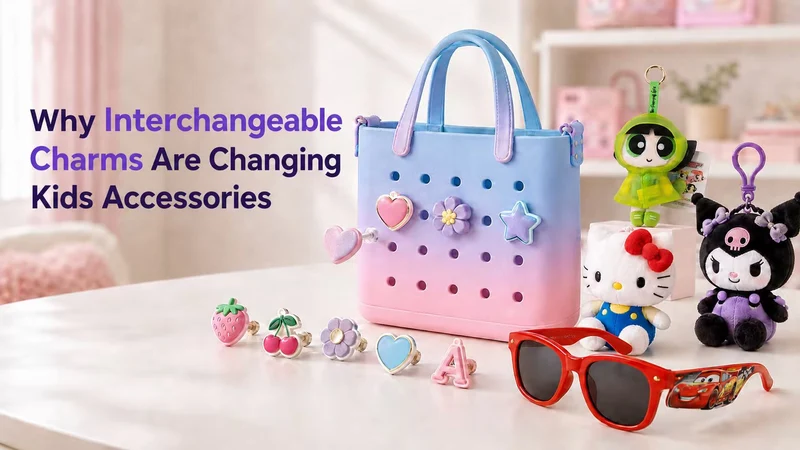
What Are Interchangeable Charms?
Interchangeable charms are removable decorative components that can be attached to a product in different positions or combinations. Depending on the accessory, they may be connected through specially designed holes, loops, rings, clips or other suitable attachment structures.
Unlike a permanently printed or fixed decoration, an interchangeable charm gives the user more control over the final appearance.
A child may choose a fruit charm for one occasion, a letter charm for another, or combine several colors and shapes to match an outfit, mood or favorite theme. The base product remains functional, while the decorations can continue to change.
This concept can be applied to:
- Kids bags and backpacks
- Bracelets and necklaces
- Keychains and bag charms
- Phone charms and wristlets
- Cosmetic bags and small pouches
- Hair accessory holders
- Seasonal and promotional products
The result is an accessory that combines everyday function with creative participation.
1. Personalization Is Becoming Part of the Product
Children often use accessories to express their preferences. Color, shape, texture and decorative details help them show what they like and how they want an item to look.
Interchangeable charms make personalization part of the product structure rather than an optional extra. Children do not have to accept one fixed design chosen by the manufacturer. They can make small changes themselves and create a combination that feels more individual.
For example, one child may prefer hearts and flowers, while another may choose animals, fruit or letter charms. Even when both children own the same base bag, the final appearance can be different.
This creates an important advantage for brands and retailers: one product can appeal to a wider range of visual preferences without requiring a completely different bag or accessory for every design variation.
2. The Product Becomes More Interactive
A standard accessory is usually purchased, worn and stored. An interchangeable product adds another activity: choosing and arranging the decorations.
Children can decide which charms to use, where to place them and how often to change the combination. This simple interaction can make the accessory more engaging without adding complicated electronic features or instructions.
The product can also change with different situations. A child might create one arrangement for school, another for a birthday party and another for a holiday outing.
This type of interaction gives the accessory a playful quality while maintaining its practical purpose. A bag still carries everyday items, a bracelet remains wearable, and a keychain still decorates a backpack—but the child has more involvement in how the product looks.
3. One Product Can Offer Multiple Looks
A fixed design provides one appearance. An interchangeable charm system can create several combinations from the same base item.
Charms can be:
- Rearranged into different positions
- Mixed with other compatible designs
- Matched with different outfits
- Updated for holidays or special occasions
- Replaced when the child wants a new theme
- Combined with initials, symbols or favorite colors
This gives customers more styling possibilities without requiring them to purchase a completely new base product every time they want a different look.
A strong example from our own range is the COOLS Gradient Kids Tote Bag with 3 Interchangeable Charms. The front panel includes multiple attachment positions, allowing the three charms to be removed, moved and rearranged. The pastel blue, lavender and pink bag remains practical for daily use, while the charm system lets children create different visual combinations.
The design demonstrates how customization can be incorporated into an everyday children’s bag without making the product difficult to use.
4. Interchangeable Charms Can Increase Perceived Value
The value of a children’s accessory is not determined only by its material or size. Customers also consider how much enjoyment, use and variety the product provides.
A standard bag with one fixed decoration offers one finished style. A bag supplied with several interchangeable charms gives the customer more choices and a more interactive experience.
This can make the product feel more complete and giftable. Parents may see practical value in the base item, while children are attracted by the ability to customize it.
For retailers, this combination can support a stronger product story. Instead of displaying the item only as a bag or bracelet, it can be presented as a customizable accessory with several possible looks.
Clear packaging, product photography or display examples can show different charm arrangements and help customers understand the feature quickly.
5. Charm Systems Create Collection Opportunities
Interchangeable charms do not have to remain limited to one product. A coordinated charm theme can be extended across multiple accessory categories.
For example, the same collection could include:
- A tote bag with removable charms
- A matching charm bracelet
- A coordinating phone charm
- A keychain using the same decorative elements
- Hair accessories in matching colors
- Sunglasses or cosmetic bags with related details
This allows wholesale buyers to build a recognizable collection while offering different product types and price levels.
At COOLS Accessories, our product range includes hair accessories, jewelry, kids bags, sunglasses, beauty products, keychains, bag charms and phone charms. This multi-category structure provides practical opportunities to develop coordinated charm concepts instead of treating each product as an isolated item.
A fruit-themed charm collection, for example, could appear on a bag, bracelet, keychain and phone accessory. Retailers can then display the products together or sell them individually across different departments.
6. Licensed and Original Designs Can Both Benefit
Interchangeable charm systems can be used in both licensed and non-licensed children’s accessories.
For licensed projects, buyers may develop a group of approved character elements, symbols or themed objects. Children could then arrange the charms in different combinations while the overall product remains connected to the licensed collection.
The concept does not need to rely only on a large printed character image. Colors, icons, recognizable objects and supporting design elements can all contribute to the product theme, subject to the relevant licensing requirements and approval process.
For non-licensed products, buyers have even greater flexibility. Charm themes may include:
- Animals
- Fruit and desserts
- Hearts and flowers
- Sports elements
- Letters and initials
- Fantasy symbols
- Holiday icons
- Fashion and beauty themes
COOLS Accessories supports both licensed product programs and original COOLS or private-label collections. Charm quantity, shape, material, color and attachment style can be developed around the buyer’s target market and price positioning.
7. Retailers Can Refresh a Product Without Replacing the Base Design
Retail assortments need regular updates, but developing an entirely new product structure for every theme can require additional time and investment.
A compatible charm system creates another option. Retailers may retain a successful base product while introducing new charm themes for different retail periods.
For example:
- Flowers and pastel colors for spring
- Fruit and ocean themes for summer
- School-related icons for back-to-school programs
- Pumpkins or playful monsters for Halloween
- Snowflakes, stars or festive designs for winter
- Letters and hearts for gifting programs
This approach can help a familiar product feel new while maintaining a consistent basic structure. It can also make collection planning more flexible because decoration themes can be adjusted for specific markets, promotions or seasons.
However, compatibility must be considered from the beginning. Attachment dimensions, charm weight, placement and product structure should be standardized carefully so that each component works correctly with the base item.
8. Interchangeable Designs Support Repeat Engagement
When a product can accept different charms, the relationship between the customer and the accessory does not necessarily end after the first purchase.
Retailers can introduce additional charm themes, coordinated products or later collection updates. Customers who already own the base item may be interested in expanding the way they use and style it.
This creates opportunities for:
- Additional charm selections
- Themed charm packs
- Holiday updates
- Limited-edition designs
- Coordinated accessories
- Gift-with-purchase charms
- Exclusive retail combinations
The purpose is not simply to add more pieces. Each new charm should give the customer a clear reason to update or personalize the product.
For wholesale buyers, this means planning the base item and future charm possibilities as one product system rather than as unrelated SKUs.
9. Safety and Usability Must Be Designed Carefully
Because interchangeable charms are removable components, appearance should never be the only consideration. The attachment system must also be appropriate for the intended age group and product use.
Buyers should review:
- Charm dimensions
- Attachment strength
- Ease of removal and replacement
- Sharp edges or rough surfaces
- Component weight
- Material selection
- Age grading
- Required warnings and labeling
- Testing requirements for the destination market
A charm should be easy enough for the intended user to handle but secure enough for normal product use. The size and attachment method may need to change depending on whether the charm is used on a bag, bracelet, necklace, phone accessory or keychain.
These details should be confirmed during product development and sampling. Materials, decorations, attachments and finished products should also be evaluated according to the relevant regulations and buyer requirements for the target market.
10. What Wholesale Buyers Should Decide Before Development
A successful interchangeable charm product requires more than selecting several attractive decorations. Before starting development, buyers should define the complete product concept.
Important decisions include:
- Base product: Will the charms be used on a bag, bracelet, keychain, phone charm or another accessory?
- Target age group: This influences charm size, attachment structure, usability, labeling and testing requirements.
- Charm quantity: The product may include several charms or leave additional attachment positions for future additions.
- Theme direction: Buyers can select licensed characters, original illustrations, seasonal icons, letters, animals, fruit or other themes.
- Attachment method: The system must suit the product structure and intended use.
- Color coordination: The base product and charms should work together while still allowing different combinations.
- Retail presentation: Packaging should clearly demonstrate that the decorations can be removed and rearranged.
- Future expansion: Buyers should decide whether additional charms or matching categories may be introduced later.
Addressing these questions early helps create a product that is attractive, practical and suitable for production.
Developing Custom Charm Products with COOLS Accessories
Yiwu COOLS Accessories supports global brands, importers, retailers, distributors and private-label customers with custom children’s accessory development.
Our categories include hair accessories and jewelry, beauty products, kids sunglasses, bags, wallets, keychains, bag charms, phone charms, seasonal products and licensed merchandise. This allows interchangeable charm concepts to be developed across several related product lines.
Depending on the project, our OEM and ODM support can include:
- Base product development
- Custom charm shapes and themes
- Licensed or original artwork adaptation
- Material and color selection
- Charm quantity and placement planning
- Coordinated multi-category collections
- Custom logos and private labeling
- Retail packaging development
- Sampling and production coordination
- Quality and compliance support
Our existing gradient kids tote demonstrates how a practical product can be combined with three movable charms to create a more personal and interactive design. Similar concepts can be adapted for different colors, themes, product categories and retail programs.
Conclusion
Interchangeable charms are changing kids accessories because they transform a fixed product into a customizable experience. They allow children to influence the appearance of their accessories, give one item multiple styling possibilities and help retailers create collections that can continue to develop over time.
For wholesale buyers, the opportunity extends beyond adding decorative pieces to a product. A well-designed charm system can connect bags, jewelry, keychains, phone charms and other categories through one recognizable theme.
By combining practical products with removable, rearrangeable decorations, brands can offer children greater choice while creating new opportunities for coordinated collections, seasonal updates and repeat engagement.
Yiwu COOLS Accessories develops licensed and non-licensed children’s accessories for wholesale, OEM, ODM and private-label programs. Whether you are planning a customizable kids bag, charm jewelry collection, keychain series or multi-category accessory range, our team can help turn the concept into a market-ready product.