
How to Choose a Kids Accessories Manufacturer for Your Brand?
August 27, 2026
Choosing a kids accessories manufacturer requires more than comparing unit prices. A suitable supplier should match your product categories, target market, customization needs, quality requirements, order volume, and delivery schedule. Buyers should also review material control, product testing, packaging, communication, and production management before placing an order. For brands sourcing kids accessories wholesale, the right manufacturer should support both current orders and future product development. For example, a growing brand may begin with hair clips and jewelry, then add bags, beauty sets, charms, and seasonal products. A supplier with multi-category capabilities can support that expansion without forcing the buyer to manage several unrelated factories.
The first step is to define what your brand actually needs. A retailer may need standard products with custom packaging. An emerging brand may need a custom collection from sketches or reference samples. A distributor may need stable wholesale supply across several categories. These projects require different supplier capabilities.
The second step is to evaluate how the manufacturer works. Look at product development, material sourcing, sampling, production control, inspection, packaging, and logistics. A low quotation can lose its advantage if the supplier cannot maintain quality or meet the required delivery window.
The third step is to verify whether the supplier understands children’s products. Kids’ accessories often require closer attention to materials, small components, age grading, labeling, and destination-market requirements. The manufacturer should therefore understand the difference between ordinary fashion products and products intended for children.
For brands entering a new market, supplier selection should become part of the product strategy rather than a simple purchasing task.
What Should You Look for in a Kids Accessories Manufacturer?
A reliable evaluation starts with the manufacturer’s actual capabilities. Buyers should avoid judging a supplier only from product photos or a short quotation. A professional assessment should cover product range, production resources, customization, quality control, communication, and supply chain management.
1. Product Category Coverage
Start by checking whether the manufacturer can support the categories required by your brand.
A children’s accessories collection may include:
- Hair clips and pins
- Headbands and scrunchies
- Fashion jewelry
- Jewelry and hair accessory sets
- Beauty and grooming accessories
- Nail art and manicure products
- Keychains and bag charms
- Kids sunglasses
- Backpacks and fashion bags
- Wallets and coin purses
- Seasonal accessories
- Holiday collections
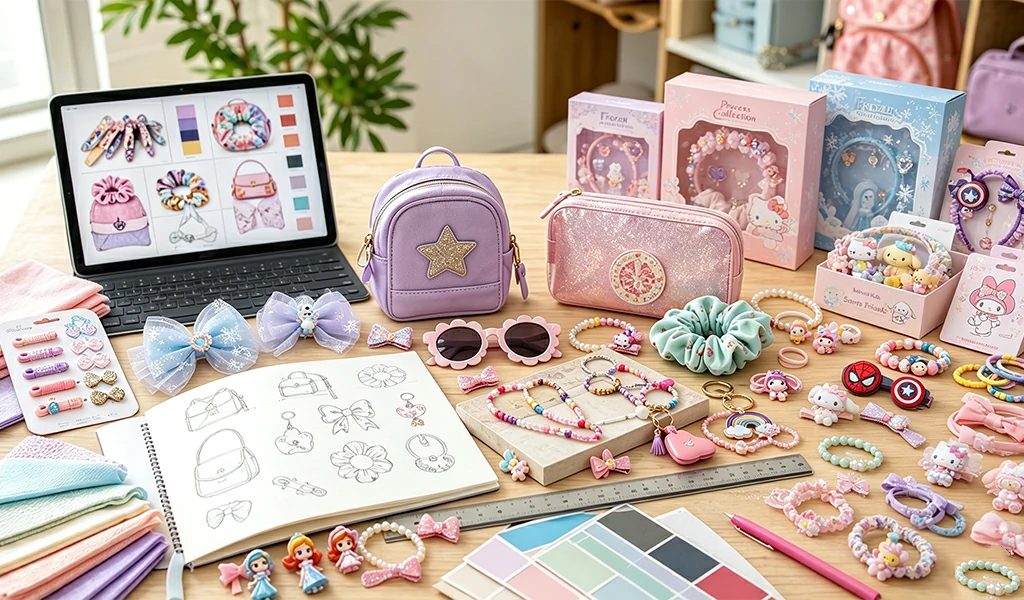
COOLS currently covers several of these categories across its product range. This includes hair accessories, jewelry, beauty products, keychains, charms, kids sunglasses, bags, and seasonal products.
A broad product range matters when your brand wants to create coordinated collections. For example, a summer collection could combine sunglasses, hair accessories, a small bag, and matching charms.
A supplier that handles several categories can also reduce communication between different factories. This can simplify sample reviews, packaging coordination, inspection, and shipment planning.
You can review the full range of children’s accessories before deciding which categories fit your product strategy.
2. Manufacturing and Supply Chain Resources
The term “manufacturer” can describe different business models. Some companies produce products directly. Others coordinate factories within a manufacturing cluster. Some combine both approaches.
The distinction matters because your project may require several production processes.
For example, a custom hair accessory may involve:
- Material sourcing
- Component preparation
- Color matching
- Assembly
- Logo application
- Quality inspection
- Packaging
- Carton packing
A multi-category collection may require several additional production processes.
Therefore, ask how the supplier manages its production network. Ask who handles sampling and who controls bulk production. Also ask how quality information moves between the supplier and production facilities.
For brands sourcing from China, access to established manufacturing resources can help with category expansion. COOLS operates within the Yiwu supply chain and supports multi-category product development.
3. Experience With International Buyers
International orders involve more than manufacturing.
The supplier should understand specifications, packaging requirements, shipping documents, labeling, carton information, and communication across different time zones.
This becomes especially important when your brand sells through retail chains or e-commerce platforms.
Ask whether the supplier has experience with:
- Brand-specific packaging
- Barcode labeling
- Product specifications
- Export documentation
- Inspection coordination
- Consolidated shipments
- Retail packaging
- Private label projects
The goal is not to find a supplier that claims to serve every market. The goal is to find one that understands your actual sales channel.
How Can You Evaluate an OEM Kids Accessories Supplier?
OEM projects require more technical communication than standard wholesale orders. The supplier needs to turn your specifications into a manufacturable product.
A good OEM process should begin with a clear product brief.
The brief should explain the product type, target age, dimensions, materials, colors, branding, packaging, expected quantity, and target market.
Product Development Capability
A capable OEM kids accessories supplier should be able to discuss product development before quoting the final order.
For example, imagine that a brand wants a three-piece hair accessory set.
The buyer provides a reference image and preferred colors. The supplier then needs to determine the suitable materials, clip construction, dimensions, decoration method, packaging format, and production process.
A supplier that only provides a price may not be enough.
The manufacturer should identify technical issues before bulk production starts.
This can prevent changes after the first sample.
Sampling and Prototype Development
Sampling gives both sides an opportunity to verify the product.
The buyer should review:
- Product dimensions
- Material appearance
- Color accuracy
- Logo placement
- Component attachment
- Packaging format
- Overall finish
- Functional performance
Sample approval should become a documented stage.
For custom products, keep the approved sample or an approved digital specification. This creates a reference for bulk production.
COOLS states that its custom development process covers concept development, design and sampling, production and quality control, packaging, logistics, and final delivery.
Customization Options
Customization can involve much more than adding a logo.
Depending on the product, buyers may request:
- Custom colors
- Pantone color matching
- Custom prints
- Logo application
- Woven labels
- Laser engraving
- Embossing
- Custom packaging
- Private label cards
- Retail-ready labels
The correct customization method depends on the material and product structure.
For example, a woven label may suit a fabric bag. A printed logo may suit a plastic component. Laser engraving may work for selected metal surfaces.
The supplier should explain the technical limits of each method.
This helps the buyer avoid choosing a branding method that looks good in a digital mockup but performs poorly during production.
MOQ and Production Flexibility
MOQ should be evaluated in relation to product complexity.
A standard item may have a different MOQ from a fully customized product.
Custom packaging can also increase minimum quantities because packaging suppliers often require their own production minimums.
Ask the supplier to separate:
- Product MOQ
- Color MOQ
- Custom logo MOQ
- Packaging MOQ
- Sample cost
- Tooling cost
- Production lead time
This creates a clearer cost structure.
A lower product MOQ may not reduce the total order requirement if the packaging has a high minimum quantity.
How Important Are Quality Control and Product Compliance?
Quality control should be evaluated before placing a purchase order. It should not begin when the finished goods reach the warehouse.
Children’s products require particular attention because applicable requirements can vary by product type, materials, intended age, and destination market.
For the U.S. market, the U.S. Consumer Product Safety Commission states that children’s products subject to applicable safety rules generally require third-party testing and certification. The specific requirements depend on the product and its materials.
Material Control
Material selection is one of the first quality checkpoints.
The supplier should know the materials used in each product and understand the requirements of the destination market.
For example, jewelry may require different testing considerations from textile accessories. A beauty accessory may require a different review from a backpack.
Ask the supplier:
- What materials are used?
- Where are key materials sourced?
- Can material documentation be provided?
- What testing may apply?
- How are material changes controlled?
- What happens if a material becomes unavailable?
Material substitution should not happen without buyer approval when it could affect product specifications.
Production Inspection
Quality control should continue during production.
A basic production control process can include:
| Stage | Main Check | Buyer Consideration |
|---|---|---|
| Material preparation | Material type and appearance | Does it match the approved specification? |
| Pre-production | Sample and process setup | Does production follow the approved sample? |
| In-process production | Dimensions and assembly | Are defects appearing during production? |
| Finished goods | Appearance and function | Does the final product meet requirements? |
| Packaging | Labels and quantities | Is retail information correct? |
| Pre-shipment | Cartons and quantity | Is the shipment ready for dispatch? |
Caption: Typical quality control checkpoints for a kids accessories project.
The exact inspection plan should match the product.
A simple hair clip may require fewer checkpoints than a multi-component bag with printed graphics, metal fittings, and decorative charms.
Testing and Documentation
Buyers should identify applicable requirements before mass production.
The CPSC states that testing requirements can vary according to the product class, intended age audience, consumer use patterns, and material composition.
This means a supplier should not promise that one general test covers every children’s accessory.
Ask for a product-specific compliance plan.
For U.S. children’s products subject to applicable safety rules, the responsible manufacturer or importer must support certification with required testing. The CPSC also notes that a Children’s Product Certificate must be based on applicable test results.
The buyer should therefore clarify who will arrange testing and who will provide the required documentation.
A supplier can support testing coordination, but the legal responsibility may remain with the manufacturer or importer depending on the market and product.
How Should You Compare Kids Accessories Wholesale Suppliers?
Price is important, but it should not be the first and only comparison point.
Two suppliers may quote different prices because they use different materials, packaging, inspection methods, production processes, or order assumptions.
A better approach is to compare suppliers using the same specification.
Build a Supplier Comparison Sheet
Use the same questions for every candidate.
| Evaluation Area | Questions to Ask |
|---|---|
| Product range | Can the supplier cover your required categories? |
| OEM capability | Can it develop products from drawings or samples? |
| MOQ | What is the MOQ for each product and customization? |
| Sampling | How are samples developed and approved? |
| Materials | Can the supplier provide material information? |
| Quality control | What checks occur before and during production? |
| Testing | Can the supplier coordinate applicable testing? |
| Packaging | Can it provide custom retail packaging? |
| Lead time | What is the standard production schedule? |
| Communication | Who manages the project after order confirmation? |
| Logistics | Can products be consolidated for shipment? |
| After-sales | How are quality issues handled? |
Caption: Supplier comparison criteria for B2B kids accessories sourcing.
The sheet makes the comparison more objective.
It also helps purchasing teams identify hidden costs.
For example, Supplier A may offer a lower unit price. Supplier B may include custom packaging and inspection coordination. If the buyer needs both services, the initial price difference may not represent the actual project cost.
Check Communication Before the Order
Communication quality often predicts project efficiency.
Ask detailed questions before placing an order.
Observe whether the supplier gives direct answers. Check whether specifications remain consistent across quotations and samples. Review how quickly the supplier identifies missing information.
This is particularly important for custom projects.
A short product specification can contain many technical details. If the supplier misunderstands one dimension or material, the mistake may reach the production stage.
A good communication process should document decisions.
Email confirmations, product drawings, sample approvals, packaging artwork, and specification sheets can all provide useful records.
When Should You Choose a Custom Kids Accessories Supplier?
Custom sourcing makes sense when standard products cannot meet your brand requirements.
A custom kids accessories supplier can help develop products around a specific brand identity, retail concept, character theme, or seasonal collection.
Custom Product Development
Consider a retailer planning a back-to-school collection.
The retailer may want:
- A themed backpack
- Matching hair accessories
- A small wallet
- A character charm
- Coordinated packaging
Buying each item from a separate supplier may create inconsistent colors and packaging.
A multi-category custom supplier can coordinate the collection around one product brief.
This approach can reduce the number of separate production discussions.
It can also make the final product range more consistent.
Private Label Projects
Private label buyers usually need stronger brand control.
The project may involve custom product colors, logo placement, packaging, labels, and retail information.
The supplier should confirm what can be customized before the buyer approves the quotation.
Ask for packaging samples before bulk production.
Also confirm whether the same artwork will appear across different product categories.
A consistent visual system can make a multi-product collection easier to manage at retail.
Licensed Character Products
Character products add another layer of project management.
The buyer needs to confirm the licensing arrangement and approved product specifications.
The supplier may need to coordinate product adaptation, packaging, artwork approval, and production.
COOLS currently supports licensed character product development as part of its broader children’s product services. Its published workflow includes IP selection, design adaptation, prototype development, approval coordination, production management, and retail packaging.
This type of project requires more coordination than a standard private label order.
Therefore, buyers should confirm who owns each approval step before production begins.
What Questions Should You Ask Before Signing an Order?
A supplier evaluation should end with specific questions rather than general impressions.
Product Questions
Ask what materials the supplier recommends and why.
Ask whether the design can be produced at the required quantity.
Ask whether the supplier has produced similar structures.
Ask whether the product requires molds, special tooling, or custom components.
Commercial Questions
Confirm the MOQ and pricing basis.
Ask whether the quotation includes packaging.
Ask whether sample charges are refundable after bulk production.
Confirm payment terms and production lead time.
Ask how price changes will be handled if raw material costs change.
Quality Questions
Ask what inspection standards the supplier follows.
Ask when inspections occur.
Ask whether third-party testing can be coordinated.
Ask who reviews the final shipment before dispatch.
Ask how defective products are handled.
Logistics Questions
Confirm carton dimensions and estimated gross weight.
Ask whether different product categories can ship together.
Confirm the preferred shipping terms.
Ask whether the supplier can provide export documentation.
These questions help purchasing teams identify gaps before production starts.
What Are the Most Common Mistakes When Choosing a Supplier?
Many sourcing problems come from incomplete specifications rather than poor intentions.
Choosing the Lowest Quote
A low price can be useful, but it should not replace technical evaluation.
If the quotation excludes packaging, testing, inspection, or certain components, the final project cost may increase.
Always compare equivalent specifications.
Selecting a Supplier From Product Photos Alone
Product photos show appearance.
They do not show material documentation, production control, testing, MOQ, or delivery performance.
Request samples and technical information before making a decision.
Ignoring Product Category Fit
A supplier may be strong in one product category but unsuitable for another.
A jewelry supplier may not have the same capabilities as a bag supplier.
If your brand needs several categories, evaluate whether one supplier can coordinate them effectively.
Discussing Compliance Too Late
Compliance should be considered during product development.
Changing materials after sampling can affect color, cost, structure, and production timing.
For U.S. children’s products, CPSC guidance emphasizes that testing requirements depend on the specific product and applicable rules.
The buyer should therefore identify the destination market early.
Approving Samples Without Written Specifications
A sample is useful, but written specifications provide stronger production control.
Record dimensions, materials, colors, logos, packaging, and other critical details.
The final production should follow the approved specification.
FAQ About Choosing a Kids Accessories Manufacturer
What should I look for in a kids accessories manufacturer?
Look at product categories, OEM and ODM capability, sampling, MOQ, material control, quality inspection, compliance support, packaging, lead time, communication, and logistics.
Is a manufacturer better than a trading supplier?
Not automatically. The right choice depends on the project. A manufacturer may provide stronger production control for certain products. A supply chain company may provide broader category coverage. Buyers should evaluate the actual capabilities behind the business model.
What is the difference between wholesale and OEM kids accessories?
Wholesale usually involves selecting existing products from a supplier’s range. OEM involves developing products around the buyer’s specifications. OEM projects normally require more sampling, customization, and technical communication.
What does an OEM kids accessories supplier provide?
Services may include product development, material selection, sampling, branding, packaging, production coordination, inspection, and logistics support. The exact scope depends on the supplier and project.
What is the typical MOQ for kids accessories wholesale?
There is no universal MOQ. It depends on product type, materials, customization, packaging, and production process. Buyers should request the MOQ for each product and customization element.
Can I order different kids accessories from one supplier?
Yes, some suppliers support multiple categories. This can include hair accessories, jewelry, beauty products, bags, charms, sunglasses, and seasonal products. Confirm the supplier’s actual category capabilities before placing a multi-category order.
How do I evaluate a custom kids accessories supplier?
Start with samples and product specifications. Then evaluate material control, customization methods, quality inspections, testing support, MOQ, lead time, packaging, and communication.
Do children’s accessories need safety testing?
Some children’s products require testing under applicable regulations. The exact requirements depend on the product, materials, intended age, and destination market. U.S. requirements, for example, can require third-party testing and certification for children’s products covered by applicable safety rules.
Should I ask for product samples before ordering?
Yes. Samples allow buyers to check dimensions, materials, colors, construction, branding, and packaging. For custom products, sample approval should happen before mass production.
Can a supplier help with custom packaging?
Many OEM suppliers provide packaging customization. Options can include header cards, blister packaging, window boxes, labels, and branded cartons. Confirm the available formats and MOQ before finalizing the order.
How early should I contact a manufacturer?
Contact suppliers before the planned launch date allows time for product development, sampling, testing, packaging, production, inspection, and shipping. Custom projects usually require more planning than standard wholesale orders.
Cools: A Kids Accessories Manufacturer for Multi-Category B2B Projects
Cools has developed its business around children’s accessories, product development, and supply chain coordination. The company supports brands, retailers, wholesalers, distributors, private labels, and e-commerce sellers with multi-category children’s products. Its current product range includes hair accessories, jewelry, beauty products, keychains, charms, kids sunglasses, bags, and seasonal collections.
For brands looking for a kids accessories wholesale supplier, Cools provides access to a broader product range rather than focusing on one accessory category. This can help buyers coordinate collections across several product lines.
Cools also supports custom development. Its published workflow covers concept development, sampling, production, quality control, packaging, logistics, and delivery. The company lists customization options that include Pantone color matching, custom prints, logo branding, and private label packaging.
For OEM projects, Cools can support product development from an initial idea or reference sample. Buyers can define the product structure, materials, colors, branding, packaging, and target market. The supplier can then coordinate the development and production stages.
Cools also works with licensed character products and supports IP-related product development. This can be relevant for retailers that want to build character-based collections across bags, jewelry, charms, hair accessories, and other categories.
The right manufacturer should fit your business model, not just your current order. A supplier that can support sampling, customization, quality control, packaging, and category expansion can become more useful as your brand grows.
When comparing manufacturers, focus on the complete supply process. Review product capabilities, communication, MOQ, samples, compliance, quality control, packaging, lead time, and logistics. A clear evaluation framework will help your purchasing team make a more informed decision.
References
- U.S. Consumer Product Safety Commission, Third Party Testing Guidance.
https://www.cpsc.gov/Business–Manufacturing/Testing-Certification/Third-Party-Testing - U.S. Consumer Product Safety Commission, Children’s Product Certificate.
https://www.cpsc.gov/Business–Manufacturing/Testing-Certification/Childrens-Product-Certificate - U.S. Consumer Product Safety Commission, Initial Certification Testing.
https://www.cpsc.gov/FAQ/Initial-Certification-Testing - U.S. Consumer Product Safety Commission, Selecting a Third Party Laboratory.
https://www.cpsc.gov/FAQ/Selecting-a-Third-Party-Laboratory - U.S. Consumer Product Safety Commission, Rules Requiring Third-Party Testing and a Children’s Product Certificate.
https://www.cpsc.gov/Business–Manufacturing/Testing-Certification/Lab-Accreditation/Rules-Requiring-Third-Party-Testing